Episode Transcript
Brian Hubbard (00:00)
the fear is that most people think that it's going to take over their job. If you use it as a tool, as a thing that helps you produce faster, it's just like the computer going from hand drawing to CAD.
It's just speeding things
You shouldn't be afraid of it.
Tim Carroll (00:13)
Welcome to Culture at Work, the podcast that explores how to maintain a strong corporate culture in a rapidly changing world. I'm your host, Tim Carroll, inviting you to learn from industry leaders on how to build an exciting culture to bring people back to the office and inspire them like never before.
Tim Carroll (00:34)
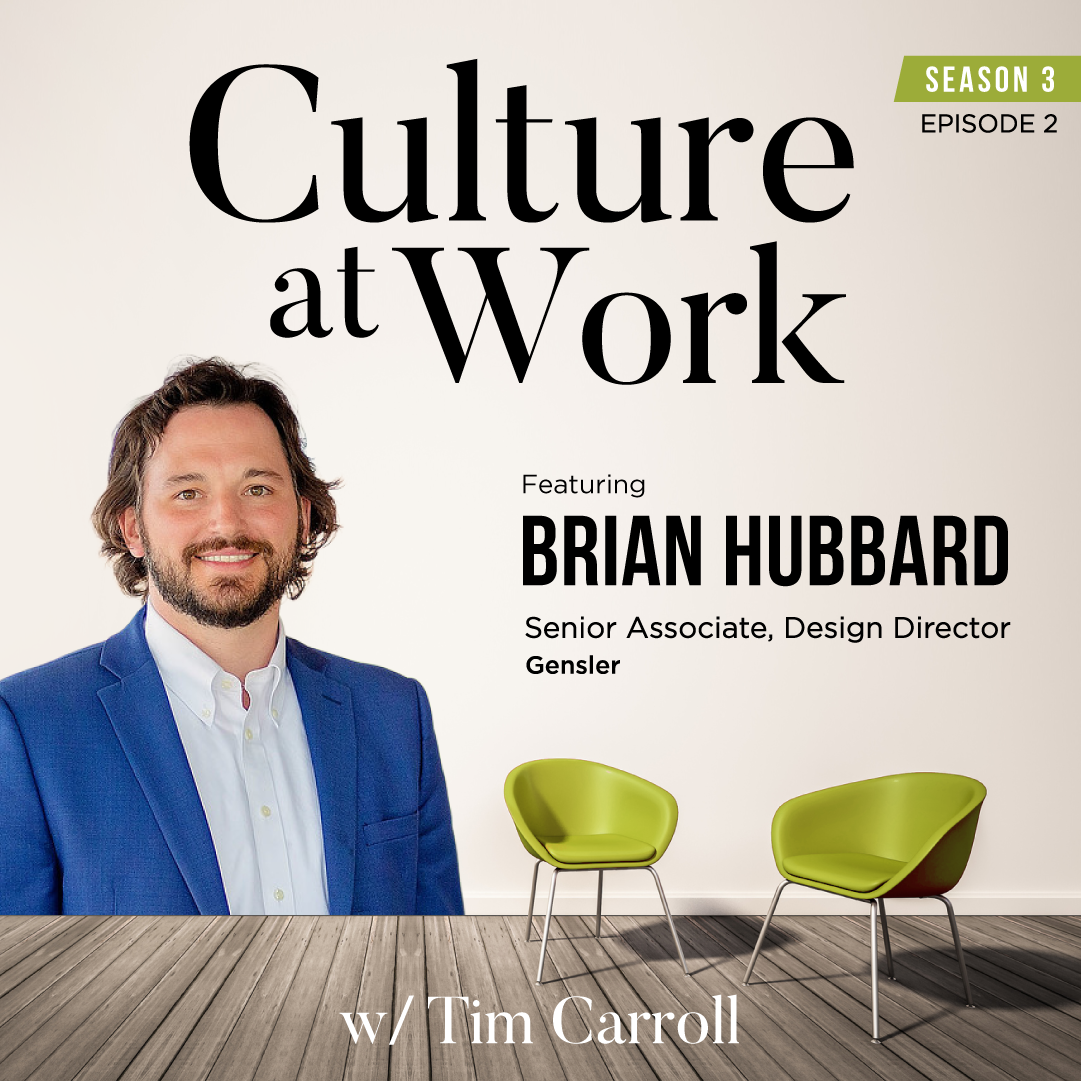
On today's episode, we have Brian Hubbard, Design Director for Gensler Nashville. Brian brings a wealth of design expertise shaped by work across continents, scales, and project types. As a Design Director for Gensler Nashville, his portfolio spans intimate, small-scale buildings to transformative urban developments and master plans that redefine cityscapes. This breadth of experience equips him
with a nuanced understanding of the distinct challenges and opportunities each project presents. A firm believer in the power of exploration and iteration, Brian leads teams through a rigorous design process, one that encourages testing, questioning, and refining every potential solution. This mindset fosters deep collaboration and drives the creation of innovative site-responsive designs
that harmonize aesthetics, environmental stewardship, and operational excellence. Known for embracing complexity and pushing boundaries, Brian consistently delivers unconventional standout solutions. His commitment to elevating project outcomes and surpassing expectations makes him a trusted partner and a dynamic team player dedicated to cultivating strong, lasting relationships with both colleagues and clients.
This is going to be great. Let's get to it.
Tim Carroll (02:05)
Hey, Brian, thank you so much for joining us today. I really appreciate your time.
Brian Hubbard (02:09)
Absolutely, Tim. Happy to be here.
Tim Carroll (02:11)
So I'm excited about this conversation, your background, your architect, you're a leader of a large organization and part of a much larger organization at Gensler. And so I'm really excited about this conversation, but I want to start the same way we always start, and that is with the same question, how do you define culture?
Brian Hubbard (02:30)
It's the people, obviously. It's all starting with the people. It's a collaborative, innovative, creative class type people that fuel a family bonded atmosphere. And without your family, you really have nothing. So I think the people that we've hired and the people that we empower as leadership, I think it's really what defines our culture as a community and a family of innovative thinkers.
Tim Carroll (02:51)
leading an organization and then coaching organizations on culture and driving change. Are there things that you learn from that that you bring to the table with the clients just from it? Is there an interesting perspective you get from that from leading as well as coaching?
Brian Hubbard (03:08)
Yeah, I mean, we try and
and organizations that match our culture.
when we do our best work, when everything is aligned. But I think coaching people to help understand what it is that their constituents, what their base, what their employees really
the future of their workplace, I think is a really fun moment where you get to dive into data, dive into
what it is that drives and fuels their workforce.
Tim Carroll (03:35)
In the commercial furnishings industry, filling the right position takes more than resumes. It takes relationships. That's what sets the McSweeney Group apart. For over 25 years, Marilyn McSweeney and her team have built trusted connections across manufacturers, dealers, A&D, and corporate clients. We don't just search for candidates. We know the talent, understand the culture, and deliver results that stick. When the role is hard to fill, and only the best will do,
Choose the recruiting partner that knows this industry inside and out. The McSweeney Group, different by design.
Tim Carroll (04:14)
When you look across Gensler's portfolio right now, what's the most surprising shift you're seeing in how clients define a great workplace? And that, I have found it's shifted since COVID, but what do you find that clients are saying this is now what a great workplace looks like?
Brian Hubbard (04:31)
Experience driven. I think you can see it all the way across from workplace to sports to education to health. It's the experience that somebody has coming to arriving and being a part of a facility. I think when I think of office space and companies occupying its location, location, location, that's always been the same thing. But it's really providing the amenities that give time back.
So it's ⁓ providing the daycare, it's providing the service level elements that help give people time and make their life less stressful. And that can be outside, but then internally it's the same thing. It's like what experience internally will reduce my stress and give me more of my time back.
Tim Carroll (05:08)
Do you feel that the office is moving more towards a personalization within the office?
Brian Hubbard (05:14)
Yeah, I think that's where you've got the hospitality trends that really, you know, you think of when you arrive at any given hotel, they greet you obviously with a, hello, Mr. Carroll. And then there's also personalization in your rooms. personalization in your lighting, the whole way that things are set up. So when you arrive, it is exactly how you like it. So if you think about that in the workplace, it's the lighting, it's the temperatures, it's...
just the overall kind of feel of the space that you want to occupy is personalized to you.
Tim Carroll (05:43)
So you mentioned hospitality and of course that's absolutely crashing the workplace party right now. you know, and some call it homing from work and they call it a bunch of different things, but there are some principles from residential and hospitality that are getting infused into the workplace.
And so what are some of those principles that you feel are moving the needle outside of personalization, but what are some of the moves that are happening that really help that employee experience?
Brian Hubbard (06:12)
well, one that's a physical thing is the lighting within a space. The things that draw you through, if you think of office spaces that are evenly lit all the way across, like there's no intrigue or interest drawing you through a space. It's the layers of a space as well. As choice, there's always different rooms of where you want to exist. So if you want to go and exist at the bar, meet a lot of people, or you want a small room where you want to get work done, there's choice within a hotel that is coming and seeping into.
our workplaces. So it's whether or not you want to do work. It just allows you to work anywhere.
Tim Carroll (06:42)
That choice and control of where and how people work, it's so important. And we work with clients on that as well and trying to create spaces that encourage movement throughout the space. But you mentioned lighting, and I find that an interesting topic. But that's something that I don't think many of us, and definitely people that aren't in the industry, probably don't pay enough attention to.
Talk to me a little bit more about how, it can affect everything. You have the best space in the world, but poor lighting is going to make you unproductive, ⁓ unhappy.
Brian Hubbard (07:16)
I mean, you can think of the circadian rhythms that you'd have while sitting next to a window. The light changes from early morning light to mid-day light that's just super bright, super blue. But then in the evening, it gets that warm ⁓ glow type light. It's in our chemistry. It's something in our biology that allows us to really feel comfort and connection to the outdoors that
we're seeing a little bit more integration in office spaces, but also it's just the overall comfort level of like sitting below a 6,000 Kelvin light. You don't want to do that. That's, it's a very blue light and it's not comfortable. It's appropriate for certain situations, but often not appropriate for office spaces. But even just the ambient lighting that creates interest and intrigue of drawing you through a space, whether it's at the baseboard or in the cove lighting, just something softer, something a little more human.
it just feels like a more relaxing environment.
Tim Carroll (08:07)
So we all use data to drive decisions. I mean, as business leaders, we're all data, data, data, you know, and God we trust all others must have data. But how do you balance that from this kind of right brain, left brain idea of design and then data, those two worlds don't always seem to be the worlds that would mesh the best. But how do you balance data-driven space planning?
with the human factors like belonging and mentorship and culture, you know, those things that don't show up on a dashboard. How do you balance those two things?
Brian Hubbard (08:41)
Well, you've got to interview. Just looking at data, you would design a space completely different than if you actually interviewed the people and understand where that data is coming from, where those numbers are, the questions specifically whenever they get hyper specific about their space and how they use the space. Oftentimes you've got to get outside the two ends, the polar opposites and get to that middle portion to understand what affects most people in the space.
we're talking to is like, if you're in a car going 35 miles an hour and you're standing outside, it's the same speed, but you interpret it and feel different. So what's your comfort level interior to a space? And not saying people are driving cars through office space, but you know, there's a way that we use space and there's a way that we interpret somebody's using it. So you've just got to get both sides. And I love data, like more data, the better. And it just,
better informs what you're doing and the outcomes. And there's also a way that you can then explain why you've done something. And then you can make a value judgment on whether or not that needs to be a driving factor. Does it help productivity? Does it improve overall environmental outcomes and comfort and feel? There's always, it's not just data that you're relying on, there's still intuition that people utilize to make decisions.
Tim Carroll (09:49)
What are a couple of the questions that you would ask in an interview to get the ball rolling with a client to start to figure out who they are?
Brian Hubbard (09:57)
I don't want to give my secrets away to him. Come on. I, you know, I think. Yeah, I think asking people what keeps them up at night, you know, what is it that's a stressor for you? You going through whether you're downsizing a space, you're creating a new campus for your company. It's what about this project is going to keep you up at night? And if we can make sure that that
Tim Carroll (09:59)
about how do you define culture? think that's a really great question. What's the culture of your organization?
Yeah.
Brian Hubbard (10:21)
person who's leading this effort is comfortable and has all the information to make the right decision and feel great about it. That's what we feel like is defined as a really great project. It's about them, it's not about us.
Tim Carroll (10:32)
What are a couple of the data points? So we talked about data and data points. What are a couple of the data points that you are your go-to? And a second question to that follow-up would be, what data points do you wish clients would be tracking themselves?
Brian Hubbard (10:46)
Uh, well, um, that's a really, I think whenever we talk about density, like how dense does the space need to be from a work, uh, you know, how big is the desk? How is your work changing? You know, are you utilizing if you're again, improving and going to a new space, how's your work changing and how does it impact your furniture that you're going to buy and purchase? it have flexibility for you to evolve over the next?
seven to 10 years as your lease goes up. I think from ⁓ what I wish they were looking at, sometimes occupancy, like are people really using these spaces that you have? So analyze your current space as much as you possibly can to understand and then use that against how people feel about the space. There's almost a comfort. Like is there a reason somebody's not using a room because it's outdoor influence of sounds and light?
Tim Carroll (11:18)
Right.
Brian Hubbard (11:34)
Like you could design it, put the best furniture in there ever, but it's always hot from the hours of 12 o'clock to five o'clock. It's just, what are the other comfort elements that people analyze and need to have in order to use a good space?
Tim Carroll (11:49)
How would someone go about doing that? If they don't have the technology, obviously there's technology out there that can do that stuff for them, right? But if they don't, are you talking about going old school and just sitting there and writing down, you know, what you see and observe?
Brian Hubbard (11:57)
Yeah.
Yeah, that's pretty much what you would be doing if you didn't have the technology to analyze occupancy and comfort levels and daylight analysis.
Tim Carroll (12:11)
But it makes a huge
difference, right? mean, to help someone like you design a space for them to have that data and understand, do you really need this space? And do you really need this space located here, right?
Brian Hubbard (12:22)
Yeah.
I mean, I think there's some, obviously, experience there might be, you cast it as bias of like where you place things, where you place rooms, where you place workstations. Do you create neighborhoods? Do you create one large open space? Are open spaces
down work or is it more for collaboration?
a very loud space. So the switch of heads down work being in small conference rooms are
you know, the pods or things like that, instead of it being for the open space, that's where you're to connect and that's where all your teams are at.
Tim Carroll (12:53)
Flexibility seems to be the hot word right now in our industry. so talk to me about how that's changed and what you guys are doing to accommodate the flexibility that people are wanting to achieve.
Brian Hubbard (13:07)
Yeah, it's choice though. Flexibility, it's not about a table being multiple things. Well, yes it is, but it's ⁓ choice and flexibility within the space that you design. could a space accommodate teams working there together? Could it also flex and be a space that's meant for gathering and celebrating? So it's, you know, of course the sit stand desk is always a great flexible element, depending on again, on the choice of what you want to.
how you want to work. I think of large conference rooms depending on how that person does work. It all goes into what the company needs to fulfill their mission and their work.
Tim Carroll (13:41)
Okay, we're gonna break away for just a quick message and we'll be right back after this.
Let's get back to culture at work.
Tim Carroll (14:32)
So you talked a little bit about personalization of a space and how you can go from space and have that space change for you. That's behind the scenes, I would imagine, by AI. And so let's go ahead and talk about it. It's one of those things that is changing the design world.
a great deal, scary for some and the changes that it's making. Don't believe it should be. I'm anxious to hear your thoughts on it, but AI is touching everything from programming to change management. So where is AI already improving your design process and outcomes?
Brian Hubbard (15:09)
⁓ we've fully embraced it from the storytelling aspect to the iteration. It's something that we have fully embraced as a firm, creating our own specific, G diffusion and other elements that help us keep our IP, you know, make sure that it's something that we have created with ourselves, not with other outside worlds intellectual property. But it's something that I think helps us
iterate quicker, ideate quicker, and it's one of those things that also helps remove any kind of writer's block. If you're thinking about something and you wanna get to the next thing and you're you're stuck, it's just like taking a walk and asking something to give you a different perspective. It's just like connecting with that super experienced individual that said, I designed 25 different spaces. It just gives you a different perspective. It's still on you to be the curator.
you still need to say what is good design, what connects with your client, what connects with their workforce and deliver that. So it's still a fantastic tool. You shouldn't be afraid of it. I think you just need to embrace it.
Tim Carroll (16:05)
I like the idea of writer's block. It definitely does that. It will get you going if you are stuck. It's now more like a writer's speed bump. But the fear of AI is...
As it relates to design, yes, I think it can help speed some things up, maybe help some accuracy help with the writer's block from a design perspective.
But without the human interaction, it is just a thing that does what you ask it to do, right?
Brian Hubbard (16:34)
Right, it's with any data. Good data in is good data out or bad data in is bad data out. it's still a tool that can't just, I mean, sure, you can write really great prompts. And I think my nine-year-old could easily say, design me the next office of the future. And it's like, well, okay, what does that look like? Like, are they on tablets and everything's like minority report? Okay. But again, sure. Right, yeah.
Tim Carroll (16:55)
⁓
Brian Hubbard (16:57)
The ultimate flexibility, just a large LED tech wall that lets me do anything I want. But I think the fear is that most people think that it's going to take over their job. If you use it as a tool, as a thing that helps you produce faster, it's just like the computer going from hand drawing to CAD. You continue to do things faster and pick up mistakes faster, having to erase things with an electric eraser.
It's just speeding things up.
Tim Carroll (17:22)
I used Chat GPT once and I put in and I wanted to create something and it came out with this design, very basic and for something for my personal life. And I went somewhere else in the country and saw a design very similar to that.
I was like, don't know anything about you. I don't know anything about your company, but I know you use chat GPT because I have something that looks just like it. And I feel like that's the sameness that design through AI is going to bring us. And anybody that cares about having personalized creation doesn't want to do that.
Brian Hubbard (17:57)
Well, that's interesting. I mean, there's the sameness in architecture as it used to be if you went over in Europe and other countries, they had a very unique style to them. But the Western influence in architecture has created glass boxes everywhere over the world. So I would say it's less AIs fault than the Western world influencing design all the way around. You can see it in cars. Every car is black and white, really.
It's like color has gone away from people and from design because everything's just these muted colors. So when is color coming back to really influence? And really, when do you think about what connects with a local culture? I think that's the part that's kind of missing in that ⁓ situation is that everybody kind of wants this, everybody, but like they wanted a really plain aesthetic, a really modern and minimalistic element. And that sometimes is devoid of culture.
Tim Carroll (18:33)
Right.
Brian Hubbard (18:44)
and it removes that locality of where you're designing for. But I think that's what it's your job, our job, is to bring that back.
Tim Carroll (18:51)
So let's bring it back to culture and let's talk about if a CEO gave you 10 % of their project budget and they wanted you to invest purely in culture outcomes for their company, where would you put it and why?
Brian Hubbard (19:07)
Well, one, think we already do some of that. We do it a lot with the people and leadership. I know you probably meant going to a project type, but for a second, it's about people. know, people first, it's an Arts book, Arts principles. You can learn all about Gensler's culture. It just is dependent on the people to execute it. And investing in leadership and making sure people are able to grow where they want to. You you can define kind of your own
way here at Gensler. It's an entrepreneurial mindset that you can find a way and a path that you want to go on and we'll support you on that. And it's everything that we do from a G-Emerge and G-MBA helping people because we are in the business of design. At the end of the day, we still are a business. So we've got to understand how that leadership, the business mindset, connecting with the right clients and creating a culture that we're all owners. Right. It's a way that
you have ownership over your own destiny. We're here just to help you find what it is that you wanna do. But if you talk about like project specific type elements, I know you want me to say furniture, furniture's great.
Tim Carroll (20:06)
Of course outside of it. I furniture
is of course the number one thing, but let's take that aside
Brian Hubbard (20:10)
Exactly. Yeah.
I think it would be time. And I know that's not a physical element, but on a project, you always want more time to think and iterate and design and detail and think about how things could influence the way you feel, the way you move through a space. It really just, the more time that you get, the more you can affect little nuances throughout things. it's whether it's, you know, thinking about a lighting code detail and not just trying to apply it all the way around the building.
or around the space, what is really intimate about each work location that you might interact with. So it's more getting back to that personalization, that time allows you that personalization and create a really fantastic space to exist in.
Tim Carroll (20:50)
Do you find that people under, and by people I mean maybe clients, but do you find that people undervalue the importance in your world of that thinking and iterating and that time that you need in order to really come up with something dynamic?
Brian Hubbard (21:09)
It depends. It really depends on the company and the culture. Is that company that you're working for innovative and understand that it takes time to come up with a fantastic building design slash interior, then no, they fully respect it. If it's something of a commodity space, then maybe sure they expect a little bit more, you know, bland flavor across the way. You know, the whole everything kind of feels the same to your point earlier. It just depends on the company. Depends on the person that you're talking to and going back.
We want to find the right clients, the right partners along the way that value that creation at that time.
Tim Carroll (21:41)
You mentioned something a minute ago about the business of design. And I'm curious from your perspective, if you find newer designers that that's a challenge for them to understand that there is a business to this. We design, but there's a business. And we've got to think about it as a business. Otherwise, the business won't be around for long.
And how do you get them from a culture standpoint? How do you get them more towards that ownership mentality mindset?
Brian Hubbard (22:14)
I mean, there are certain people that want to worry about that. There are others that you don't want to saddle them with the worry of the business side. Let them create. They are their best when they don't have to worry about that. And that's why you've got so many different points of leadership along the way. We have design leadership that is fully thinking about what's the next innovative thing that we want to do and how we're going to design it and what's pushing us to the forefront.
We have people that think about resiliency and sustainability and it's not their job to be thinking about business. It's their job and like, how can we improve the process? How can we influence a city? I think whenever people, it's something that I always wanted to do is understand the business side. And that's what drove me into this position. So I love being able to create and connect and influence more than just the 5 % of design.
Tim Carroll (22:52)
Right.
Brian Hubbard (23:01)
You you think about in the grand scheme of real estate and building and constructing, that design period is really like a five to 10%. There's so many forces on the front end and the back end that really you can be a part of. And that's something I've enjoyed learning more about how to influence those along the way.
Tim Carroll (23:17)
Brian, thank you so much. I really appreciate your time. Excited for everybody to hear this and really the exciting things that you guys are doing with AI and how you're embracing it. I think that's a testament to what we all should be doing. So thank you so much. I really appreciate your time today.
Brian Hubbard (23:32)
Absolutely, Tim. Enjoyed it.