Episode Transcript
Tiffani Bova (00:00)
If you make every decision solely for the benefit of the customer and you ignore the needs of the employee, it's just gonna get worse.
Tim Carroll (00:07)
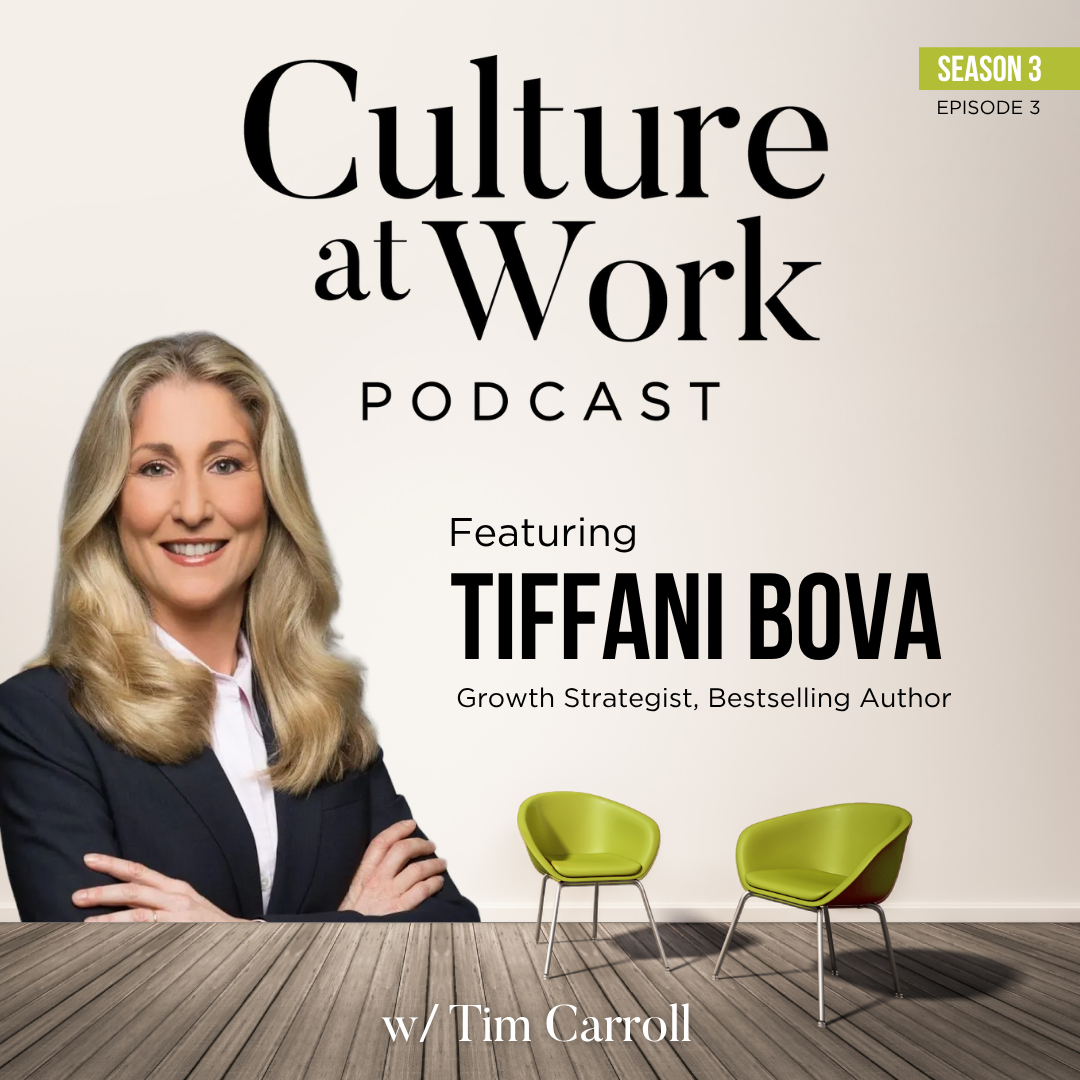
Welcome to Culture at Work, the podcast where we explore what makes great companies and great people truly thrive. I'm your host, Tim Carroll. Today, I'm thrilled to be joined by Tiffani Bova, bestselling author, keynote speaker, and global growth evangelist. She's the former growth and innovation evangelist at Salesforce, a top 50 business thinker, and host.
of the What's Next podcast. Her latest book, The Experience Mindset, explores how aligning employee and customer experience drives real growth. Get ready for a master class in leadership, culture, and the future of work. Let's get to it.
Tim Carroll (00:54)
Tiffani, thank you so much for being with us today. I am honored to have you on here. I am excited about this conversation. I think you're going to find out why momentarily, but thank you so much for joining us today.
Tiffani Bova (01:07)
Tim, my pleasure, my pleasure, no place I'd rather be.
Tim Carroll (01:09)
Well, let me tell you, full disclosure, we are a client experience organization. We focus on the client experience today because of your book. We're going to be focused in 2026 on balancing client experience and the employee experience. It has made a huge impact on me and we're very much at our company readers. And so we're going to be starting to read. I've read it, but
The company is going to read it as a whole in December. So excited for this and to have you on to ask you a million questions that I can.
Tiffani Bova (01:43)
Well, listen, when you write a book was never my goal, but when you write a book, you hope someone reads it. So now I know, Tim, someone's read it. Awesome.
Tim Carroll (01:49)
I have, I have,
I want to start this out. We, this is a podcast called Culture at Work. We asked the same question at the beginning of every podcast and episode, and that is, how do you define culture?
Tiffani Bova (02:05)
Such a good question. I'm gonna answer this not short, because it's kind of a little bit of a journey for me, right? I'm not a culture expert. It's just, it's not a lane, as you know from my book, I say it in the first page, like literally, like it's not a lane I have spent a whole lot of time on. I've spent a lot in growth, I spent a lot in customer experience, and it was a blind spot for me. It's not I don't understand culture and understand sort of what it means, but I never knew and really truly understood the.
that it had until I started working at Salesforce and I was standing on stage one day and I said, I'm no longer at Salesforce, but when I was, one, Salesforce is a great place to work globally, one of the most innovative companies in the world, and then the fastest growing enterprise software company. And after I said that, I was like, I wonder if I could ever prove it. And I wonder if the reason it's so innovative and the reason it's growing fast is because it has this strong culture. And that took me down this path. So,
Now, finally, I think I have an answer versus going, well, culture is defined as, and give some academic one, but it is really the collection of the people at an organization, what they're empowered to do, at least in my mind, what they're empowered to do, and how quickly they can make decisions guarded by the rails that the culture has really put in place. Like, ooh, that's just out of bounds for us. It's not something that feels good to me. We're not going to do it.
Tim Carroll (02:59)
Yeah, right.
Tiffani Bova (03:21)
that is a human, hold on a second, it's just, doesn't align to what we're trying to do as a company and or something we would never say. that, and also it's a then leaders don't like. Like how do you measure a feeling? Like, do my employees love what they do? Ooh, I don't like that word love. Like, know, ultimately it isn't a poster. It is really how your people show up every single day.
Tim Carroll (03:35)
Right.
Tiffani Bova (03:46)
and your customers will remember that engagement much longer than anything else. Not your brand name, not your price, not how great your offices were. will be how your customers felt when they engaged with your people.
Tim Carroll (03:58)
You know, it's interesting what you say there. And you do mention this, and I talk about this all the time, that nothing can grow that isn't measured, right? And that's the thing about culture. It's really tough. It's enigmatic. That's why I like to ask the question to begin with, because it's really difficult to define sometimes, and more importantly, sometimes difficult to measure. So I love that.
Tiffani Bova (04:22)
And I think it's,
you know, it's not just about what you say, it's about what you do. I mean, that's so cliche, right? But if you have a leader that says one thing and does something totally different, then there's a culture mismatch. Or if, you know, if the company expects people to do something and everyone does something else, then So I think it is really in the way people do things and the way they behave, especially when, you know, highly stressed or, you know, overloaded with work.
or burnout is setting in, like all those things start happening. That's where you really start to see what the culture of an organization is.
Tim Carroll (04:55)
So what have you seen, I you talk about it being the soil where CX and EX can grow. I what do you see the best companies, and you talk to a lot of them, you've been part of a lot of them, where do you see that the best cultures are reinforced from both rather than just forcing them as separate?
Tiffani Bova (05:12)
Yeah, and I think this goes back to what I was just saying in my definition and on this journey I've been on is I have been talking about the power of customer experience for a long time. mean, I was part of the team at Gartner all the way back in 2008 that made the prediction that the chief marketing officer would spend more on technology than the chief information officer. And you can imagine when we said that, especially being a Gartner analyst, whoa, whoa, CIO is the one who spends all on tech. And this is sort of...
during the early days of shadow IT, because the internet was still kind of new and, know, SaaS applications were starting to pick up and we weren't doing it because we thought the CMO was going to buy tech. It was about understanding that that customer experience is what was going to become this new battleground between brands that good enough products could win if they delivered a better experience. And we knew that experience was moving digitally. Then we knew that the CMO was owning the digital roadmap.
So we knew they would take on more and more of customer experience. So then we argued that the CMO needed a seat at the executive table because they tended to be tucked under the COO or the CEO. Now you see the CMO sitting at the executive table and then all of sudden the chief customer officer popped up, you know, about a decade ago, right? It really focused on the customer. And it was this, and me included, True North customer all day, all day. And what companies did was they forced this
Tim Carroll (06:22)
Right.
Tiffani Bova (06:31)
easier experience for a customer on the shoulders of the employees. Because if you take it away from a customer and it's not automated, the manual task ends up being in the employee's lap. Or if a system isn't working efficiently or there's too many processes or not a good workflow, the customer never sees any of that, right? You're like, we never want to expose our dirty laundry to the customers that we have to do 92 things. When they hit a button, they feel like it happens instantaneously. But then five people have to jump through seven hoops to get, it happen.
Tim Carroll (06:55)
Yes.
Tiffani Bova (06:59)
So we move the effort from the customer over to the employee and that's where it got out of whack. And so that really led to that work of the experience mindset of understanding that we have to hold employee experience. Like is employee experience our true North or is customer experience our true North? And I actually think it's the wrong question. I think it has to be an and play. It's at different points in time of a company. They'll get a little out of balance. It's never going to be 50 50, but you might pivot more to employee or you might pivot more to customer.
Tim Carroll (07:19)
Right.
Tiffani Bova (07:27)
based on what's going on in your business. But if you make every decision solely for the benefit of the customer and you ignore the needs of the employee, it's just gonna get worse. If you make every decision for the employee with no idea of the impact to the customer, it also doesn't work, right? You have to be able to ask the question on both sides.
Tim Carroll (07:44)
That's right.
Yeah, and look, we do focus a lot on the client experience. It's just our mantra. But we do have a focus on the employee as well, very much so. But I just feel like that is a given, and it's not a focus.
⁓ and it's not an initiative and I feel like it to me and please, I'd love to hear your thoughts on it. I feel like it should be an initiative within an organization. It can't just be. Of course we care about the employee. Of course we're going to make decisions about the employees that benefits the employee. It's gotta be an initiative that everybody just as much as they understand we're focused on the client. They gotta be just as in understanding that we're focused on the employee, right?
Tiffani Bova (08:31)
Yeah, and I can ask a simple set of questions. What are your executive KPIs?
Tim Carroll (08:36)
So we, mean, obviously sales. I mean, we do have that as an executive KPI, but development of revenue. absolutely. And the development, we really do focus on the development of the individual at the company. The guiding star for us is our strategic plan at the beginning of the year that really focuses around the development of the individual.
Tiffani Bova (08:38)
Okay.
Well, it's really revenue. It's really revenue, right? Right. Yep.
Tim Carroll (08:57)
And a rising tide will lift all ships at that point. If we're all getting better today than we were yesterday, we will be better as a company. That being said, we're still very focused. That's important to us. So the employee is important, but we're still very focused on the client experience.
Tiffani Bova (09:12)
Yeah, but so I'm going put you on the spot here. You didn't answer the question. What's the KPI?
Tim Carroll (09:14)
Yeah, please do.
Yeah, so for us, we tracking to the development goals? Yep.
Tiffani Bova (09:22)
For example, let me sort of
for example, right? So if you say we're very focused on the customer, our KPI as an executive team is revenue is one, that's sort of a given, that's an obvious, right? Second, it might be net promoter score or customer satisfaction score, right? Like a KPI, like, okay, everybody at the executive level, like I am holding you, okay, if you have a $100,000 bonus and we hit a revenue number, you know, great.
Tim Carroll (09:30)
Of course.
which it is. Yep.
Tiffani Bova (09:46)
But if our customer satisfaction scores, our net promoter score is down quarter over quarter significantly, then you're not gonna get your full bonus. I mean, KPIs, right? So if you have a net promoter score and then you might say, okay, then there's some other KPI that might be in there, right? It could be usage, could be a churn rate, right? Like whatever your managing KPIs are. So what I like to say to executives is I want you to pull out those that are customer oriented like net promoter score as an example, okay?
Tim Carroll (10:13)
which we have.
Tiffani Bova (10:14)
And then I say, I want to balance in KPI and employee. So you said, what was your metric? Like you want to invest in your people, right? Okay. So then I would say, I want you to balance a net promoter score with an employee net promoter score or an employee satisfaction score. So what is your employee satisfaction score at the beginning of the year? Q1, Q2, Q3, Q4 is an up, down, flat. So if you're investing in people, that's one way you get employee satisfaction up, but it isn't the only way.
Tim Carroll (10:21)
right, the development of each, you know.
Tiffani Bova (10:43)
Right? Is it, feel heard, I, you know, I give ⁓ feedback and people listen to me or, you know, I am trained or I feel I have the skills I need to, but whatever those questions are, what we heard through the research was everyone surveys their employees, yet 87 % of executives don't know what to do with that data. So now what the employees hear is, I told them something, they don't listen, they don't care, I don't care. Right? So if employee engagement is dropping, I guarantee you,
a quarter or two behind that employee dip, you will start to see customer satisfaction dip. It just, it naturally happens. So it is the canary in the coal mine in this case. So if you have a customer metric, I want a matching employee metric. I don't care what it is, right? Like, let's just say you journey map the customer, how they buy from you because revenue is number one, right? So I'm going to guess you've journey mapped how customers buy things from your company. Okay.
Tim Carroll (11:38)
Correct.
Correct.
Tiffani Bova (11:39)
Have
you journey mapped what employees have to do to make that sale happen? To open and close that customer service ticket. Have you journey mapped doing a return? Have you journey mapped the heck out of the customer, but you have not journey mapped the employee, yeah.
Tim Carroll (11:46)
Yeah, so yeah.
Right?
We have absolutely journey mapped the client. Not as well, although we do know exactly our process. We do have a net promoter score that we just started this year. So again, and because we're a client experience organization, how can we say that if we don't have something tracking that? So we do that and we do the surveys.
two times a year, we go through satisfaction we don't have and I think that's a great thing for 2026 to
Tiffani Bova (12:23)
Well, and if you're just like,
So you do it twice a year. So I'm going to put you on the spot and you don't have to answer this. you know, right. But if I, if let's just say, you know, I was advising you, literally, I'd be like, great, you do that survey. Tell me the top three things that came out of the first half of the year survey. And what did you do to fix it? And what came out of the second half of the year's survey? And what did you do to fix it? What were the top three things? So now let's go back to those KPIs.
Tim Carroll (12:27)
Yep.
Tiffani Bova (12:44)
One of the KPIs of the executive team would be, we take the top three things that are ailing our employees the most and we fix them. Right? And so, well, we did the survey and we all went, woo, we got, you know, a score, average score of 8.1 out of a score of one to 10. Woo-hoo. And then nothing happens, right? Because it's a blend. You might have one group that was really low and one group that was really high. So it's giving you this false sense of security. So going back to, if you do Net Promoter, do employee.
Tim Carroll (12:50)
Yes.
Tiffani Bova (13:12)
But the journey mapping on the customer side, I would say, you sort of on a wall, I literally did this with a client in Brisbane, Australia, and we took a wall and you did a line, above the line was everything the customer had to do to buy something and to do something with them. And below the line was everything the employee had to do at that step for the customer, right? So, okay, customer enters their, you know, credit card information and hits order, right?
And then, so underneath that, it might say something like, okay, an employee gets that order and then actually has to place it, or they have to verify it, like whatever they do, right? And or a return, working with a company out of Canada and it took 22 minutes to do a return, per return. Could have been a $5 return or a $500 return, still 22 minutes. And they had been journey mapping, but they left off all these things that the employee had to do. So for that company in Brisbane, once we...
sort of align those with the customer did what the employee did. Sure enough, we actually asked the employees everything they did. Very quickly, you realize that for every one step of the customer, it was like five to eight steps for the employee. So how do we minimize that? It might not eliminate it, but geez, really eight? So you're kind of like an eight times 15 steps is like a lot of things an employee has to do. And so that's
Tim Carroll (14:26)
Right.
Tiffani Bova (14:27)
just takes time. So you can automate it, you can stream late it, you can change the workflow, you can empower them not have to get approval for something, whatever it is. But that's why I called the book, The Experience Mindset. It's the same coin, one side employee, one side customer. And the mindset shift is what I'm talking about. Anything you do for customer, you should also do for employee. Anything you do for employee, you should do for customer. Now, not 100 % of the time, but let's say,
If you aren't doing that today, if you just started doing it 50 % of the time, it would be better, right? Or 25 % of the time it would be better. And you get, the muscle gets stronger and stronger. And then you get to a point where you never have a discussion about customer or employee without someone raising their hand and going, we can do that very quickly, but we don't have anybody trained on our employee side to be able to catch that ball today. So we'll need to train them and then we can turn it on. Where an executive might be like, I want it on today.
Right. And so someone goes, executive wants it on today, the switch, let's turn it on. And the employees are all going, Whoa, what is this? Like, I don't even know what's happening. And with all the great intention of satisfying that customer is first and Archer North and we wake up, live and die on the Hill of our customers. You've what you've told employees is I don't care if you fumble the ball, you got to work it out, right. Figure it out. And I, and I think that's where you have low satisfaction. And I think that.
Tim Carroll (15:21)
you
Tiffani Bova (15:47)
That is also to your very first question is a signal about the culture because I am just replaceable because they don't care enough about me to not have me have to do 72 things, right? In a day that really should take me 10 minutes and takes me 30 minutes.
Tim Carroll (16:03)
I and on that subject of time, think having time mapping that as well, because that's what really got me is, yes, we need to see what the steps are that each person has to do in each of those things, but what's the time it's taking? And can we shave some time in certain places to see where the bottleneck is as well? I love that idea of journey mapping it and by time as well, not just by action.
Tiffani Bova (16:27)
Yeah. So your number one is revenue, right? 30 % of a seller's time is spent selling. Revenue is your number one. Are you hitting revenue or not hitting revenue? Are you flat? Are down? Are you feeling pressure on the fact that deals, deal velocity is slowing? know, your deals are taking longer. Like things are happening that you're like, either our pipeline has the two X or three X for us to hit our numbers, or we have to get better at closing business. Yet.
our salespeople are only spending 30 % of their time selling. So I'm just gonna double click into that. Okay, what are they spending their time doing? Well, it could be manual entry into CRM, which of course is a fun topic for me considering where I used to work. So it could be data entry, but a lot of that can be automated now. What is it? And then if I look at the average enterprise, this is a ⁓ tableau stat actually.
Tim Carroll (17:05)
Right.
Tiffani Bova (17:15)
that an average enterprise has a little more than a thousand unique applications in its four walls. Actually, it's like a thousand 62. Okay. And enterprise, a thousand 62 unique applications in its four walls. Some of it will only get used by like finance or legal. I get that. But only 26 % of them are integrated. Okay. So now you go, I'm a salesperson and I have seven tabs open to do my job.
Tim Carroll (17:40)
Right.
Tiffani Bova (17:41)
And none of them are talking to each other or to talk to each other. And the other five do not. So I'm constantly having to sort of go between app and app and app and app. And that context switching between apps in a given year wastes four weeks of time. Okay. So now I've given you a lot of stats, right? So revenues, number one, 30 % of a seller's time is spent selling. If I could give you back the seller back 10 or 20 % more time to sell.
Tim Carroll (17:55)
Yikes.
Tiffani Bova (18:08)
what would happen to their revenue? It won't be percent for percent, obviously, right? But it's going to go up because they're spending more time doing what you hired them to do. And then you're like, okay, well, if they have to log into five tools, could we make it four tools or three tools? I don't need you to consolidate tools necessarily, although that's always a good strategy, but at least, at least start sharing data. So if I just did that on the selling front, if revenue's number one,
I could, if I could find two or three hours a day where the seller could actually spend two more hours selling or three more hours selling, I think Tim, you'd be like, that's a win. Yeah.
Tim Carroll (18:43)
Right? Yeah,
I mean, I'd say if a number of years ago we went down that very path and decided if that's the first thing that needs to happen before anything else happens for us, why don't we make it to where those individuals can go do that over and over and over again as often as possible? And again, because of that, we were we got two to three X over the past five years because just creating that process that gets them out there doing what they need to do in order for
Everything else to follow behind them. So that's a that's a great point
Tiffani Bova (19:15)
And same thing, customer service or finance or HR, right? Or your billing team or whatever, right? But I get sales is the obvious because it's revenue. It's very easy to see the return on that investment. But it goes back to that employee. are they doing, right?
Tim Carroll (19:25)
Right, right.
Tim Carroll (19:31)
Okay, we're gonna break away for just a quick message and we'll be right back after this.
Let's get back to culture at work.
Tim Carroll (20:20)
So you talk about incentive structures. as a self-described novice in the experience mindset of balancing the two, making sure that we're going down this road at the beginning, how does one create incentives to help shift from just client experience focused to a balance of the two?
Tiffani Bova (20:39)
Well, it again, it has to start at the executive level, right? It has to start at the executive level. So if the executives have a balance in their KPIs and their metrics that they're running the business, then it goes down to the next layer and goes down to the next layer. Now what happens is like, if I just use experience mindset as an example, if I'm sitting in front of a room full of salespeople and I'm, let's say I'm giving a keynote, experience mindset is not so valuable to them. As a matter of fact, it might actually irritate them.
Tim Carroll (20:42)
Yep.
Tiffani Bova (21:07)
Because they're going to go, I so agree. Like I wish my manager was sitting in the room. You know what I mean? Like, okay. Right?
Tim Carroll (21:09)
Right, right. There's plenty of
people listening and saying that same thing right now.
Tiffani Bova (21:15)
Right? Okay. So if it's an individual contributor, they have very little control with what they do every day, what tools they use every day, what metrics they're measured on, right? They have very little control on that. The only thing they can control is how they show up every day. Good mood, bad mood, engaged, disengaged, right? And if you look at the Gallup surveys, like employee engagement has just not cracked, you know, like in the U S like I think 30 % ever like employees actually being satisfied.
Like, my goodness, right? What are we doing? But if you think about that, so an individual contributor can control how they show up. Then their manager has to be like, look, I wanna make sure that they have everything they need and they're empowered to have that great experience. So when they show up, they are willing to go that extra mile. When employees are more engaged, actually as employees, they're more willing to give a better customer experience. They're more willing to...
focus on customer satisfaction because they're satisfied. So you have to, it's not that everyone shares the same KPIs, but at your sort of, know, VP and above, right? Those that have more span of control are going to have a balance of both KPIs. Managers will have employee satisfaction KPIs where individual contributors may have only customer KPIs, right? Because they only have so much, they can't make their colleagues sitting next to them who's a peer.
satisfied in their job. I mean, outside of just being a good colleague, right? But so if they're not a manager of people, then they shouldn't have a balance at the executive level. It should be a very high level balance where literally you could be killing it on one side of the business. But at the other side, you know, let's just say you're killing it on employee and customers are not satisfied. You don't get a big bonus. If customers are satisfied and employees aren't, you don't get a big bonus. Like that's the way to start to change behavior. If it starts at the top.
Tim Carroll (22:41)
It's been nice. Yeah.
Tiffani Bova (23:06)
and then knowing where it gets less and less balanced, right? Because the lower you get in the organization, in the more individual contributor you have, those individual contributors to be solely focused on customer.
Tim Carroll (23:17)
You have, and that brings up a great next point, which you have a statistic that just kind of blew me away, probably a lot of them, but 69 % of employees say they would work harder if they felt better appreciated. And wow, that's crazy, right? I mean, that's just unbelievable. So how do you do that? So we're talking about all this, but how do you do this?
for a small to medium sized business that doesn't break the bank. Because I believe there's ways to do this without just throwing a bunch of cash at it. Yeah.
Tiffani Bova (23:49)
Yeah.
So, you know, I know we only have a little bit of time left, but here's what I'd say on this one is, it's small acts. I'm going to give you an example from the book. sort of the employees at this company started, the CEO, she noticed that things were sort of sense that something was kind of off on the employee level. She's like, look, I don't want to do this big survey and I don't want to hire this company to come in and make it a big deal. Like I'm going to set up an inbox.
And it was, know, if you have kids in listening to this at this time, like turn down your volume, but the name of the inbox was stupid shit we do at and company name. Okay. Super simple. And she literally said, me one thing. It's the stupid stuff we do that if we fixed it, would make your job much better. Sure enough, there was only 80 people in the company. got 80 emails. Everybody had one stupid thing. And then quickly she banged through with the executive team like, okay, this we could fix quick. This will take us a little more time. This is a longer term fix.
This we can't fix because we're in a highly regulated industry. So going back to what you were saying, it's not just about money. It's, you know what? I said this wasn't working for me. Leadership heard me and fixed it.
I feel appreciated. My voice matters. My opinion matters. So I'm gonna go that extra mile because they go that extra mile for me. And so the survey is only as good as the work you do behind the survey. Otherwise, it's just a pat on the back for, yep, we're doing a good job. HR did their thing. They checked the box. We all moved on. But if you're really trying to make a fundamental change, it can be asking more questions, listening better.
Tim Carroll (24:55)
Right.
Tiffani Bova (25:16)
watch undercover boss, the TV show, and you'll know exactly what I'm talking about, right? That if you don't get out of your office and you don't ask questions, you don't uncover the basic blocking and tackling that you've gotten too far away on. If you're listening to this and you're like, look, I'm a company with a team of five, that's a different discussion. You get to a couple hundred employees, you get further and further away from the day to day.
Tim Carroll (25:19)
Yeah.
Tiffani Bova (25:39)
which means you're further and further away from the reality of what your people are actually feeling and further and further away from the reality of your culture back to sort of the topic of this whole conversation. So it can be small little moves. It isn't just about money. It's about, they ask my opinion? Do they listen to my answer? Do they fix something? When I raise something, do they allow my voice to be heard? Can I participate? Can I do stretch projects? Do they invest in my future? Do they offer me opportunities to
maybe learn new skills, especially right now, agentic and AI. And so are they teaching me ways to use it? Are they challenging me to be better and to move up and around in the organization? Those things I just mentioned did not say, pay me more money, right? And so they may say, like, I might make a little less than I might make if I left, but you know what? I feel like I'm challenged every day, I'm appreciated every day.
Tim Carroll (26:21)
Right.
Tiffani Bova (26:31)
And in certain circumstances, people will say, I'm gonna take a little less money because I really love what I'm doing and I love where I work. Not always, but it's not just about the money. It's just not about just the money.
Tim Carroll (26:42)
So I will tell you, I'm not gonna be alone in anybody listening to this. We've taken at least one thing away. I'm gonna be sending an email out of stupid stuff we do at Working Spaces and just see what responses we get back. We're gonna get that going immediately. I love it.
Tiffani Bova (26:56)
Yeah.
And one thing you got to tell them one thing and then, and then what you have to do though is you have to do a readout. Okay. We captured everybody's one thing and some, and I'll tell you if people don't give you one thing tells you you've got a culture Yeah. I don't want you to prod them. I want you to ask them one time. And if they don't just jump on it right away, then they feel like, even if they told you, weren't listening, you wouldn't listen to them.
Tim Carroll (27:02)
That's right.
Yeah, or they think I've got too many. can't just pick one. That's probably a problem too. OK, we have time for one more question and I just thank you so much for for the time you've given us. But if we're to fast forward five to 10 years. And what do you think companies that fully embrace this experience mindset? What is working space is going to look like in five to 10 years compared to those that don't do that?
Tiffani Bova (27:25)
Possible too, right? Yeah.
Yes.
I couldn't answer that in the two minutes we have left. It's just not possible. But here's what I would say. I challenge all of you to think about being agentic bosses and having agents on your org chart. And how is that now employee experience between human and digital and the collaboration and working relationship between those two so that they really do feel like.
Tim Carroll (27:48)
Yeah.
Tiffani Bova (28:08)
I talk to my team all the time. Each of you are going to have five agentic people, quote unquote, agentic, you know, ⁓ digital team members working for you. You can hire and fire them, but I'm going to know who you have and what they're focused on. And so in the definition of employee, I think will expand as agentic becomes more and more prevalent in enterprises and organizations and agent bosses are going to become
a skill set that we all are gonna have to learn. You don't want them running amok in your organization. So I'd say the experience mindset will have to include this kind of digital and human experience and how that either improves or does not improve that employee experience. I would leave it at that. I know that was a big nugget of thinking, but ⁓ it's a good one.
Tim Carroll (28:56)
I love it.
Yep. Hey, again, thank you so much. Look, I want you to know you've made an impact on me and our organization. I'm I am guaranteeing that that we are not alone. But thank you so much for your time. Greatly appreciate it.
Tiffani Bova (29:11)
Well, thank you, Tim, for having me.