Episode Transcript
Christian (00:00)
I worked my butt off, right? You worked in practice, you prepared your butt off, whatever, with the expectation that you step on that field, you're going to win. And so to me, winning was always, yeah, I met expectation, of course. Like we did what we're supposed to do. We checked the box. Now we do move on to the next one. Losing was missed expectation, right? And missed expectations, it suck.
Tim Carroll (00:16)
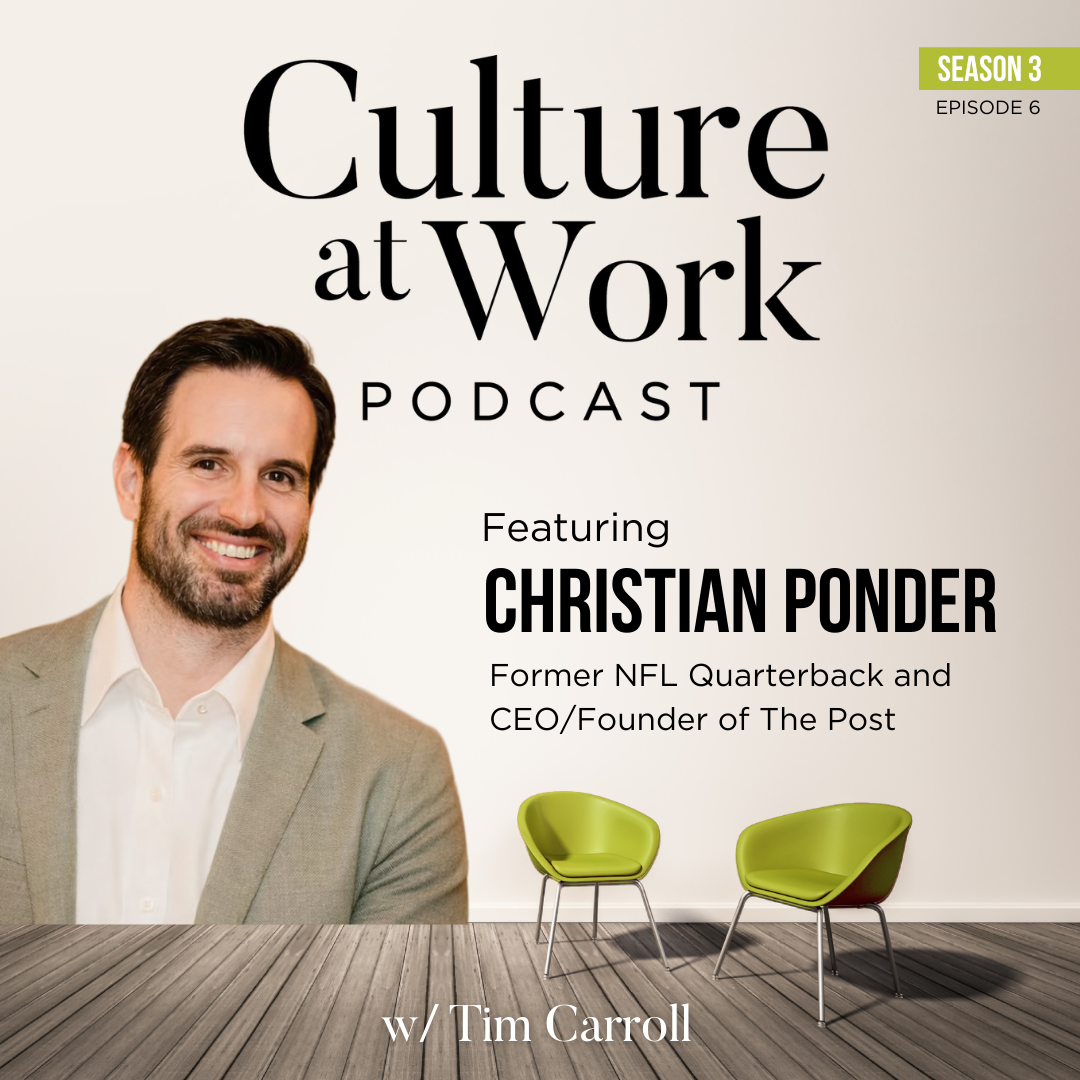
Welcome to Culture at Work, where we explore what it takes to build great workplace culture in an ever-changing world. I'm your host, Tim Carroll. And on today's episode, we have Christian Ponder. Christian is a first-round draft pick for the Minnesota Vikings, leader in the locker room, and now a voice on leadership, resilience, and life after football. Get ready for a great conversation. Whether you're into sports or not, you're going to love it.
Let's get after it.
Tim Carroll (00:46)
Christian, thank you so much for joining us today on the podcast. This is an interesting conversation I've been looking forward to just because, you know, I'm little bit of a football nerd. And I've always had this idea about culture, sports teams, college athlete. I was a college athlete. So I know a little bit about it, but you know where you're coming from.
completely different level. So I'm excited to just dive in with you today.
Christian (01:14)
I'm excited to talk, some of the things I've learned, but excited to learn from you as the culture expert. But yeah, excited to be on.
Tim Carroll (01:21)
Awesome. Well, hey, gonna start the way we always do. I have one question I ask everybody all the time, and that is, how do you define culture?
Christian (01:28)
Hmm, that's a question. I feel like I'm gonna be judged because you probably have a great definition for culture. I think it's just how we work, right? It's how we work together, whether obviously specifically in sports and how we show up as teammates for each other and towards one collective goal that we're all trying to pursue in terms of winning on the field. And there's a bunch of ways to do that. And I think just defining and building the...
the values and the behaviors and how we interact together towards that common goal. And obviously I think that translates directly into sports or sorry, in the business world or as families and yeah, that'd be my definition. I know if that's good or bad, but yeah.
Tim Carroll (02:07)
Fantastic. No bad. There's no bad answer. But I do like that how we show up for each other. And I think that's a kind of a different angle. And one that I think is especially from your background in the NFL and all that showing up for each other is an important thing. But let's dive in to the locker room a little bit and go back just a couple of years to when you were playing. wasn't that long.
Christian (02:09)
That's it, yeah.
It's been a decade now, it's a 10 year, 2016 is that 2026. yeah, I guess as you get older, as you get older a decade is no longer. Yeah.
Tim Carroll (02:31)
That decade is not long. It's not long.
That's right. Well, the decade
is absolutely short for me. What does what does a healthy locker room actually feel like? Like, what does it feel like when you're in on a team in the locker room? The cameras are off. What does that feel like to have a healthy locker room?
Christian (02:41)
Yeah.
Yeah, it's a great question. You know, it is interesting. you talk to a lot of athletes about, what do you miss most when you're when you're done playing? One of the most common answers, if not the most common answer, and probably is the most common answer is is they miss the locker room. I think reasons for that is it really is this like unadulterated, you know, as much I hate this term, it is a safe space, right? It is it is this place where these
these guys or women, obviously, you I was on, on men's teams and it was a place where we could come together and be our true selves. It felt like a place of, you know, no judgment. You know, we all knew that we had each other's backs. There was a lot of trust that what was said in locker room doesn't leave the locker room. and you know, you're just with, you're, you're with your guys, you know, that you'd have such strong relationships with. And, and that's, it's a hard place to replicate because.
I don't think there's a lot of places where you can feel that same security and that sense of, of what happens here stays here. And, and I think that's, that's why a lot of guys miss that. Cause there isn't really another place to replicate that. And, and, but it's all comes from buying it all comes from like, look, when you're on a team and football or for any other sport, but football particular, cause that's my experience is like the things that you go through day in and day out and off season workouts and training camp and games. It's like.
You build such strong bonds with each other that again, you have so much trust that this, is the space, the physical space, or even, you know, outside of the locker room. Like those are your guys that you fully trust and depend on. And it's a place where you can fully be your authentic self.
Tim Carroll (05:35)
Did you ever find anybody and name names if you would like of people that didn't have that trust that broke, I'm just kidding, don't name names, that broke that trust. Was there ever an instance where people broke that trust, like brought phone? I'm assuming you don't want phones in the locker room. You don't want people recording the stuff that's.
Christian (05:43)
Yeah.
Mmm.
Yeah, yeah, no recording.
Yeah. mean, look, sometimes, right, there'd be things that like, you know, stuff that was said there suddenly made it out, right? Like if there was relationships involved or, you know, like, and that, you know, if you want to see yourself on the outside looking in, you know, as a teammate, if you broke that trust, it was, it was hard to earn that back. And, and, you know, this is again, the good thing about
those situations like when you're that close, like guys aren't afraid to call each other out either, you know? I think we all know trust is really hard to build. It's very easy to destroy. if those opportunities, know, guys saying something, well, whatever, you know, someone reporting something to a coach, whatever it is, know, for going on for worse, right? Like if you lost that trust, was hard to earn that back.
Tim Carroll (06:37)
So quick quick story. I am a proud Gonzaga alumni. I was at the game not too long ago here in Nashville against Kentucky and for any Kentucky fans out there listening so sorry that they took a beating by Gonzaga. But it's funny. I was at the bar with a very depressed Kentucky fan and he already had heard from a buddy of his that was in the media.
that there was, whether this is true or not, I don't know, but that there was a fight that broke out in the locker room before the game, that somebody had gotten together with somebody else's, a teammate's girl, and it had already gotten out. If that's true, I was hearing about it in the middle of the game at the bar. And I would say that probably is breaking trust.
Christian (07:07)
Hmm.
Yeah, cheers.
Yeah, crazy.
that good? Yeah, that's
probably not an ideal situation. And especially, you know, if news broker for a game in terms of like, you know, someone finding out. Yeah, that's not great. And obviously, you know, that becomes a distraction, especially in game day. Like that becomes a distraction. And yeah, you know, for the benefit of Gonzaga. But yeah, that's a tough. And again, like, look, the effects of that are going to last a long time.
Tim Carroll (07:39)
And they played like this.
Christian (07:49)
You know, I don't think guys are that quick to forgive. So it's tough. It's tough situation.
Tim Carroll (07:53)
All right, so something that's always been very interesting to me. OK, so you you came out and we're with the Vikings. But you went and played with the Broncos and the 49ers, and so it's it's the quarterbacks and I'm I'm I'm specifically talking about quarterbacks because quite frankly, in my my belief, it's somebody who's just watched football my whole life. You know, they are they're driving the culture. They're the leader.
I could be wrong, but I, you know, it may be the coach or the combination, but I think the quarterback is going to carry the tone of that. And you go into a new team. How do you establish that trust immediately? Because I feel like you got to have it like day one. If you're the starter and you've got to have how do you how do you build that trust immediately before you've really earned it?
Christian (08:35)
Yeah, I don't know if you can, right? I always say leadership is earned, it's not given. And I think, going back to the Bill Belichick quote, do your job. Number one, you earn trust by doing your job. And especially in sports where, for the most part, it's purely a meritocracy, you have to do your job well. And that's how you earn respect and influence and leadership.
and is doing your job well and showing up, right? You set the tone and work ethic. mean, so much about sports is like, you got to be the first one in the locker room, last one to leave. You got to be the one working out the hardest and showing up to all the things and not missing and showing that you're committed and everyone else follows, right? And so, you you've got to set that tone early. And then on top of that, right, it can't just be I show up and I isolate myself and work my butt off. You've got to build relationships and you've got to connect with the guys and
on a personal level. I think the best that do it, you know, find ways to personally connect and take guys out to dinner or, know, whatever it is. Because so much influence is also like finding those commonalities. Like that's how you build relationship and you build trust, right? Like the science, behavioral science says, you know, we trust things that we're more familiar with and who are we most familiar with? We're familiar with ourselves. So when I can build the way that can build trust is finding ways that I
can be like that. First, I could find connection points where we have similarities and then we can start building trust. So I think it's mainly those two things. You've got to work your butt off. You're leadership influences earned through your work ethic and your performance. And then you've got to build relationships and get to know each other on personal levels and find those commonalities and those connection points.
Tim Carroll (10:11)
I've heard that, tried to live that first one in last one out kind of mentality. I've also run into a lot of other people that feel that way. And so we're all competing to be the first one in and just hanging out until way into the evening. Cause you want to be the last one gone.
Christian (10:22)
Yeah.
I know.
Especially in the quarterback locker room, I remember one team I was competing for a job, was like, we would always try to be, especially in the morning, the first one to get there. So it became like it was incrementally like two minute increments of who's going to be there first. And then at some point it's like, all right, we don't need to be here at 330 in the morning.
Tim Carroll (10:31)
Yeah.
Christian (10:51)
But I think, you know, it's for everyone else to see, you know, and at some point, right, that becomes detrimental to other things, right? I can't be at the facility at 8 p.m. I'm never gonna see my kids. you know, so at some point it's gotta fit in some sort of rational box, but yeah.
Tim Carroll (11:05)
So what, obviously we learn more from our mistakes than we do from the wins. What mistakes as it related to building trust did you make early in your career or that maybe you saw early in your career?
Christian (11:17)
Yeah.
Yeah. I mean, look, I plenty of mistakes, you know, I think, um, as, as a rookie going to NFL as a first round draft pick, you know, I had a lot of expectations and pressure and, you know, I don't know if I set the tone early on, you know what I did? So they was weird, but I got drafted, we had a lockout year. And so typically you go in and you have all these spring practices. call them OTAs, organized team activities.
And those are times where, you get your playbook and you, you know, you, you start to learn the, obviously your teammates, but also the game plan in the playbook and all these things and how you practice in the facility and where you're to live. didn't get any of that. And, and so, you know, think they felt the pressure of like, we should go get, there wasn't, there was, no veteran kind of quarterback presence on, on the team when they drafted me. So lockout ends like a week before we're supposed to have training camp, they go sign Donovan McNabb. And I think because of that, I almost took this.
laissez faire is like, all right, well, Donovan is going to be the starter. So I'm just going to sit back and, and yeah, learn from him.
Tim Carroll (12:13)
you
were 12th pick overall pick of the draft, right?
Christian (12:17)
Yeah, I was, I was. But it was like, look, Donovan obviously had a tremendous career and, and, you know, they, they brought him in to be the starter. So it was like, all right, I'm, know, I'll let him do his thing. And I think that was a mistake. think it wasn't, it was a mistake to almost take the posture I'm not the guy, you know, and, and so I'm not necessarily going to try to be, I'm not necessarily, not necessarily was a
vocal leader. think I was a mistake also in college. I was not that vocal. I was definitely more lead by example than I was vocal. I think at some point you've got to break out of that shell, especially in sports or especially as a quarterback. I think that's secondary to obviously by action. And so I think I could have been more vocal throughout my career as well. But I think specifically like
Being a little bit more laissez-faire early on, not setting the tone that I am. They drafted me to be the leader of this team. And I just think about like, look, I think I had a six year NFL career. I'm definitely proud of that. I think all of us as athletes and people in business, think about, I think more about the mistakes that I made or the things that I didn't do. And yeah, I think about, shoot, I could have worked harder. I could have done more stuff in the off season. I could have spent more time in the film room. So I think there's plenty of things that...
that I wish I would have done differently to have a better career, have better influence on my teammates and win more football games ultimately.
Tim Carroll (13:37)
Do you think things are different? I 12 pick overall, my first thought and I don't I can't remember offhand where Jackson Dart ended up, but probably not too far off of there. And I think the thought overwhelmingly was he's he's been drafted to be the starter. Do you think that's changed that mentality? Was it different 10 years ago or actually longer?
When you when you got drafted, was that kind of different that that's the natural thought? A 12th overall pick is going to be the starter.
Christian (13:59)
Yeah.
Yeah, I think, I think we were in this transitional period. think like leading up to right around that time, was like, look, you draft a guy like Aaron Rodgers, right? You draft a guy who sits behind kind of a veteran guy for a year or two, and then you draft them to become the starter. you know, I was in the midst of some of those, some guys were starting from day one. and some guys weren't. And so now I think it is you draft a guy to be a day one starter and.
And now too, like, look, I think it's yes, because that's just, that's what it is now. Right now. I think what's hard is like, look, you have a short leash and you basically have two years to prove yourself. I think we're kind of seeing that right now with JJ McCarthy. Like, look, he really didn't get, you know, his rookie year really didn't count. He was injured. didn't play. I really think this past year was actually what his rookie year should be looked at as kind of his rookie year. Like he has this next year to prove himself. And if he doesn't play well, they're going to move on. They're going to draft someone else. He's going to be, you know,
Tim Carroll (14:33)
Is that fair?
Christian (15:00)
moving on to a different team in a year. And so the leash is short now. So you have such a short amount of time to prove yourself, which makes that pressure go way up. And I think the statistic was, I think it was I mean, it was 2016, 2017. There was basically, it was like a decade of quarterbacks who were drafted first round and it was maybe 25 guys. And it was like from what, to, maybe it was 2008 to 2017. It was like, it was.
20, 22 guys were drafted first round as a quarterback. was like only two of them were still on the team that they were drafted by. And because I do, think there's, you have a short leash, you have so much pressure, you have to prepare to make that call. And was like Andrew Luck was the one guy, one of the guys in Stafford who was still with the Lions. Like those were the two guys that were still on those teams. And obviously Andrew retired and Matt's now on a different team. But it is, look, have a very short amount of time to prove yourself.
And if you don't, then you're going to be gone. But then you see other guys, look, Sam Donald just won the, you know, like he's a Super Bowl champion.
Tim Carroll (15:55)
and he was the first of
his class and they are all nuts.
Christian (15:58)
Yeah.
And he's been on, well, he went to jets to Carolina, to San Francisco, to the Seattle or to Minnesota to Seattle. So like what five teams. And finally, look, he found a team where he fit in that culture. He found a team that, you know, fit who he was and what a tree. Yeah. What a tremendous story. Um, you know, we saw Matt obviously Stafford leave the lions and do that in, uh, in LA and, uh, so it's, um, but yeah, it's just, it's a different game now. The expectations are so different for first round quarterback.
Tim Carroll (16:05)
Yeah. Yeah.
So great.
Tim Carroll (16:27)
Okay, we're gonna break away for just a quick message and we'll be right back after this.
Let's get back to culture at work.
Tim Carroll (17:17)
Just because we're having this conversation and I'm gonna take just one quick side note question to you that has more to do with football than culture. What makes that quarterback good? I have an opinion as somebody who doesn't do it that it's the processing speed, right? It's not that a lot of athletes come out, but how quickly can you process things that computer in your brain? That's the difference maker, I think.
Christian (17:39)
Yeah,
yeah. Yeah, look, ⁓ so I think playing quarterback comes out of two things. It's number one, decision making. I think that's the priority. Number two is accuracy. So I think when it comes to being able to process things quickly, that leads to better decisions. I also think what leads to better decisions, I think the guys that have stood out, Patrick Mahomes, Josh, that like...
Tim Carroll (17:40)
What's your thought? What is it that's making some of these guys better than others?
Christian (18:00)
the moment never looks too big for them. You know, they always look like they are reliant. could be games online and the Super Bowl, it's fourth and two. If they don't make this play, you know, season's over. They look the same as if it's first and 10 and the second game of the year against the worst team in the league. And so I think because they're able to act that way, like that leads to better decisions. The moment's never big. The anxiety's not ramping up. Like they're able to just make sound decisions in the moment as if it's any other play.
And then obviously the accurate side, look, you obviously got to throw the ball where it needs to be. And so I think those two things to me are what make a quarterback. Now, I think you're thinking about the NFL, like everyone probably has that bare minimum threshold of accuracy. So I think it really comes down to decision-making. Yeah. For the most part. Yeah, fair.
Tim Carroll (18:42)
I don't We've had people in Tennessee that maybe I would question whether there's minimum of accuracy. present
quarterback not included. So you mentioned decision making and that's a great segue. What do you think? We move kind of from the the football field more towards the boardroom. What do you?
What did playing quarterback teach you about kind high stakes decision making in life?
Christian (19:08)
good question. I'm still figuring that out. ⁓ I think a lot of the set as we think about like building culture and leadership, I think a lot of the same things in sports hold true to business, right? I it's really got leadership and influence. Like, look, you, have to own the things that you own at a high level before you start telling someone else what to do. I think that's again, how you build.
Tim Carroll (19:10)
Yeah.
Christian (19:28)
trust initially and then through building personal relationships. I think when it comes to decision making,
I think work ethic matters. think, I think it's athletes, right? We use, we love to use the term you control what you can control. And a lot of things that you can control, we talk about like your work ethic and your attitude or your preparation and your attitude. So I think when it comes to decision-making, how hard can I work my butt off to figure out as much, know, do, do as much due diligence as I can to help me make the right decision. How do I have great teammates around me that can help, that I can lean on to help make the right decision?
you know, so that, that batting average can be high, you know, like, look, we're not going to make every decision. We're not going to bat a thousand. we're going to have some losses. And I think when those do happen, you know, I think this is the difference between in sports and in business, like losing is inevitable. Uh, which is why I bother us and have three kids, some sports we don't keep score, you know, like which learning is a great learning or losing is a great learning opportunity. So explain to me the difference between failing and losing is failing is failing to learn from a loss.
Tim Carroll (20:26)
That's right.
Christian (20:27)
And, and so when those decisions that don't go well or go in our favor, how do I learn from these things so that I can not do that again? I mean, one of my favorite, you when we hire, one of my favorite questions is, you more love to win or hate to lose? And my theory in life is right now, hopefully someone who I eventually maybe hired is not listening to this and just going to cheat is, I will only have people that say I hate to lose.
Tim Carroll (20:50)
You
Christian (20:52)
because like for me personally, like I worked my butt off, right? You worked in practice, you prepared your butt off, whatever, with the expectation that you step on that field, you're going to win. And so to me, winning was always, yeah, I met expectation, of course. Like we did what we're supposed to do. We checked the box. Now we do move on to the next one. Losing was missed expectation, right? And missed expectations, it suck. And I think the best of it, like, I think we always point the finger at us. Like, what did I do wrong that led to this outcome? And
And that feeling just, I mean, I still think about the three interceptions I threw against Clemson in 2009. Like, what was I thinking? You know, lost us the game. Like it still pains me. And, uh, and so I want to hire someone that like, yeah, look, we did, we're supposed to do, so we won. I hate losing. I'm a driven, I can't, and not have this feeling again, but also in retrospect, when that does happen, how do I learn from this experience so that when this next opportunity comes, that loss made me better. And so hopefully those percentages of losing go down every time, um, from those learning experiences.
Tim Carroll (21:45)
Well, if you like me those losses like the three interceptions, there's a place in my stomach that I that I feel every time I think about those losses. It's like, yep, there's that one. I that one right here. That was right here on the right.
Christian (21:52)
Yeah. Yeah. It's always great. Like 1030 at
1030 at night when suddenly you just start thinking about I'll get like sweaty hands anxiety, you know, like, like, what were you doing? And, and especially that one. mean, that one, I, yeah, that one ended up actually costing me my my junior season at Florida State because I threw a third interception made a bonehead decision. I was going to take it out on the 240 pound safety and led to a third
surgery separation of my AC joint, my throne, shoulder and surgery and ended that year. And it was just like, dude, why,
Tim Carroll (22:22)
Yeah. Youth, ⁓ Yes, right. So, yeah, about decision making and I don't know if this translates back into football, but in I always talk about in decision making in corporate America, you know, I've always been taught that if you have a strategy, if you have a reason,
Christian (22:24)
Yeah, yeah, wasted on the young.
Tim Carroll (22:43)
You're intentional about a decision that you make. It may be the wrong decision, but you're not wrong. You can always pivot, right? It's the decisions that you make with no thought and you know, that just those are the ones that are difficult to recover from. And so I've always thought that that's what you got to do. If you're going to make a decision, have a strategy and an intention behind it. And pivot quickly if it's wrong.
I don't know if that really applies to playing quarterback. Because if you make a well-intentioned mistake, you're still a throw, you just threw a pick six. So.
Christian (23:10)
Yeah.
Yeah, yeah,
no, it's, it's, it's true. But, but hopefully I could have an expectation to my, or a logical explanation to my coach on like why I threw it that, through that one. And maybe that alleviates some of the, some of how pissed off my coaches at me. But, but yeah, even to your point, when, it goes back to building trust, if I can't explain to my team, why I made that decision, I mean, talk about losing trust. If I can.
Tim Carroll (23:26)
Right, that's true.
Christian (23:38)
logically explain, this is why I made that decision with intentionality. I think for the most part, people can be forgiving.
Tim Carroll (23:44)
That's right. Vast
capacity for grace when people understand why you made the decision you made. in talking about decisions, you know, I feel as if, filtering out the noise is an important part of making good decisions. And I don't know if there's anybody better that can do that than an NFL quarterback. Thoughts on that?
Christian (24:02)
I don't know. I think if you can, yes, look, I think in terms of being bombarded with the most noise, outside of probably being like the president of United States, yeah, there's a lot of people that have a of public opinions on your performance and how you're doing your job. And now in the medium of social media and 24-7 news cycles and hold...
Tim Carroll (24:03)
Defend or deny?
Right.
Christian (24:27)
channels dedicated to sports and your sport in particular. Again, there's just a lot to be said. And so if you open yourself up to hearing those things, yeah, you've got to figure out a way to be effective in blocking the noise or you just basically try to mute it, not explore it. yeah, like, look, you, part of that job today is you have to be able to handle that. And, you know, I don't, I could probably think back there are times where I didn't handle it. I mean, I allowed the noise to influence me and especially like,
you know, going back to the mistake I made in the Clemson game and messed up my shoulder in my junior year. Like I never felt like I threw the football seam after that because it was my throwing shoulder. You know, and then you start having your own internal noise about like, you're not as good as you once were. And then you start putting the outside noise on top of that and the pressure builds and builds and you deal with all these high expectations. And that becomes really hard to deal with. And so I think it is, you know, as a quarterback, yeah, I think
That is one of those aspects that's inherent to it and you're going to have to deal with it and you have to do it well. Otherwise you're to have a hard time doing your doing your job well.
Tim Carroll (25:27)
Well, so that brings up confidence. And so how do you protect that confidence when your performance dips publicly?
Christian (25:34)
work ethic, you know, I, you gotta do, think.
Tim Carroll (25:36)
I mean, I always do have a
short memory. that even, I mean, is that even possible?
Christian (25:39)
Yeah, no, I think you've got to use the noises motivation, right? You've got to use, and I just had this conversation with my 11 year old daughter, she's playing basketball and her team is not very good. And you have the option after loss, have a fork in the road, you can use it as discouragement and lose motivation, or you can use it as fuel to get back and work harder.
I think when you can send your confidence dip to me, the only way to build confidence is through preparation. And then through that preparation, it has to lead to better performance. And that's how you start to build your confidence back. So I think when your confidence dips and publicly and you hear a lot of noise, the only way reason, the only thing you could do is how do I block that noise? How do I get back, watch enough film? You know, if I'm fundamentally wrong, how do I invest in the fundamentals? The things that I need to prove upon. That's why having a
great coach is really important. the only way external noise to me, a positive external noise, that cannot be your source of encouragement or your source of confidence. I think it has to come internal. has to be, you it has to come through preparation and building that belief in yourself and then going out and doing it.
Tim Carroll (26:46)
Yeah. Yeah, I mean, that's it's you. I've been thinking of this in terms of negative noise, but you're right. Positive noise can be just as distracting and get you on the wrong path. Yeah. Yeah.
Christian (26:56)
It can't, it also can be worse, right? Cause it can lead to complacency, you know?
And I think, you know, if you're not getting better, you're getting worse. And so I think complacency is, is, is a, is a wrong place to be too. And, and then again, talking about building trust, people can see your complacent, like that's hard to hide and you're start losing trust in that influence. And I think, yeah, both, both can be, both can be detrimental.
Tim Carroll (27:18)
So you have an organization that you started called The Post and it's really aimed at college athletes, professional athletes that are making the transition into the corporate world and the things that they bring to the table. And obviously, you know, some camaraderie and networking and, and, know, iron sharpening iron and getting better. But, your contention, mine as well, and I do believe this, that
that athletes bring something different to the table, to the boardroom. So what What mindset do professional athletes carry that most executives lack?
Christian (27:50)
Mmm
Is this going get me in trouble? Is this going to get me in trouble? Yeah, think athletes are trained in a meritocracy and everything is about showing up to perform, but also showing up to perform under the umbrella about like, it's the team first, right? That like I show up to perform. Obviously I get the benefits of a good performance, but
Tim Carroll (27:51)
And you're this is recorded. this is going to.
Christian (28:14)
It's the team that really benefits. It's about me showing up for my team. And so I think in order to do that, right, you build the work ethic to prepare. You have accountability. You have humility. It's a team first mentality. and the inherent part of sports is the up and down nature of sports, right? There are wins and there are losses and this perseverance mentality, the grit, the, do I keep learning from the things that I didn't do well to make me better?
in the future, the goal orientation and the communication, right? Like we all have to be on the same page. But also it's like at the end of the day, again, it's about a win. like there's actually, I've gotten to know this professor, his name is David Hollander, he's at NYU and he runs a humanities class about how basketball can save the world. And his whole premise is if society or corporations act like a basketball team where
You know, obviously in terms of sports, we work hard, we prepare, we're on the court, we all have these roles to play, but you know, in the midst of chaos, maybe some of those roles are a bit fluid and at the end of the day, it's just about, we got to win. and I, and I think that's the, I think my time, like, look, if, the floors need to get swept, cause it's a mess in here, like, so I'll sweep the floors. Like I think it's, you know, we do whatever it takes, for the betterment of the team with the ultimate goal that we're going to win and succeed.
And how are we going to do that? Like we're going to get it done. And I think that's just a different mentality. Like, especially in today's society, I think so much of society, you know, we see the biggest companies, it's about convenience and comfort. And I think as athletes, know, you think about like, look, when we lift, when we work out with weights, right, you tear down the muscle for it to come stronger. Like we get better through adversity. We get better through doing the hard thing.
And now society, like whether we're parents or whatever, like we are averse to doing the hard, I always bring this example up. We don't even go through McDonald's, fast food, right? That was the ultimate convenience. We don't even go through the drive through McDonald's anymore. We get McDonald's door dash to our doorstep because we are so convenience and lazy. And I think as athletes, we have discomfort in that. I think we have tension when we feel lazy. I think we have tension when we feel comfortable. And I think...
Tim Carroll (30:06)
That's right.
Christian (30:16)
I think that leads to look, this constant growth mindset. How do I, can't be static. If I'm not getting better, I'm getting worse. How do I keep getting better? And how do I get my, team to be better? Cause I think we also understand we're only good as good as our weakest link. have to elevate everyone else around us so we can all keep improving together. That was very long winded answer, but I think it's a, it's a combination of things.
Tim Carroll (30:34)
I believe, I mean, given two individuals, one of them was a high performing member of a sports team, college athlete, I would say, and above. I'm taking that person because I think they have just a different gear. And in a world where we're all looking mostly, I think we're in a team environment in corporate America today. Everybody talks about the team.
bringing people that are good, good locker guys, right? I mean, that's, that's, that's an important thing.
Christian (30:57)
Yeah, yeah, yeah.
Yeah, for sure. One that's, yeah, and good locker guys, like that's building culture, you know, and that's your point. think we all, obviously culture starts at the top, but we all have a part in playing and building that culture. And it's a team game. And I think business is a team game. You know, you can't do it as an individual and you have to build the right culture to get the team bought in to show up for each other.
Tim Carroll (31:21)
So I have a shameless plug real quick is I have a new book coming out called workplace and it's all about. Hey, come on now. I gotta get on on the train here and it's it's about reclaiming in person work in a remote obsessed world and it's all about kind of presence leadership and we are better together and the best parts of work happen when we're together. So do you think a couple of things as we close out here that that culture?
Christian (31:27)
Look at you, Tim, writing books now.
Mm.
Tim Carroll (31:48)
can truly be built without proximity. And in that way, do you really think in an NFL locker room that physical presence and cohesion go hand in hand?
Christian (31:58)
Mmm.
Great question. If we thought about it, I think this is an obvious answer. If we said, if we took two NFL teams and we said one NFL team, you're not allowed to practice together on a field. You all are going to be virtually participating in practice and you're all going to do your own thing separately. And that's the only thing you could do and they could show up on game day and play. Do we think that team would have a chance against a team that was in
a practice field in a locker room every day together. Zero chance that that team would play well.
Tim Carroll (32:24)
That's me.
Is it ever the most talented team that wins? It's the team that plays the best together, right?
Christian (32:31)
Yeah. And, and, and having talent feeds into each other. And I, I look, some of the things I brought up before and building culture and leadership and influence, you know, how, how are you supposed to build trust? How are you supposed to build close relationships when you never actually see each other, you know, except through zoom and, and just even think about like the difference of like an organic conversation in an office. And then like, Hey, you know, I got something to talk about. Can we schedule zoom in 30, 40, you know, 45 minutes, like
Tim Carroll (32:35)
Sure.
Christian (32:59)
It's just a completely different dynamic. Now, do I think, can we build culture in person? And then sometimes we work remote and like, can there be a hybrid model? Sure. Is that still going to be as effective of every day we're together? No, like it's not. and, and so, you know, I think that's why like companies are realizing that I'm starting to have this call back to the office. I think it's incredibly difficult. I think, you know, this whole remote work was a necessity because obviously what happened in 2020.
Tim Carroll (33:01)
complete.
Christian (33:23)
There's a lot that don't want go back to the office and they're going to refuse to do it. And I don't think that means you need to accommodate those people. I think it's like, look, you show up or you don't. And if you don't, then you don't have a job. And yes, for sure. But I think and I hope this, I assume this is aligned with what you wrote in the book.
Tim Carroll (33:33)
then you're not our people.
Well,
100%. I mean, really, at this point, nobody needs to buy the book. They can just listen to this and it'll tell them everything.
Christian (33:48)
But again, like I think if you thought about it in sports term and there was one team that never practiced together and they did their own thing individually or remotely and on zoom and they talked about plays, whatever. And there's a group that's there every day, I think. And that's obviously not a perfect analogy, I think, yeah, look, I think it's an obvious answer.
Tim Carroll (34:05)
I do too. You can get even more out of the book and it comes out April 21st. Anyway, Christian, thank you so much, man, for agreeing to do this. Appreciate it. I you're a busy man and it's just been a pleasure to talk to you and just pick your brain a little bit about behind the scenes of what happens in an NFL locker room. So thank you so much. I appreciate it.
Christian (34:09)
Great.
Thank you, Tim. Thanks for having me. This was fun.